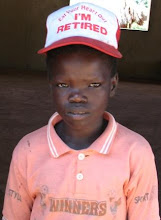
Scary Statistics – Southern Sudan[1]
September 2010
Poverty
· 50.6% of the population live on less than 2.5 SDG a day. Poverty is highest in Northern Bahr-el-Ghazal state with 75.6% of the population living below the poverty line.[2]
· 4.3 million vulnerable people will require food assistance in 2010. Of this number, 1.5 million will face severe food insecurity.[3]
Maternal Mortality
· One out of seven women who become pregnant will probably die from pregnancy-related causes.[4]
· 40.6% of mothers do not receive antenatal care at all.[5]
· Only 10.2% of deliveries are attended by skilled birth attendants.
· There are only 13.6% institutional (hospital) deliveries.[6]
· Contraceptive prevalence is only 3.5%.
· There are only an estimated 100 certified midwives.[7]
Child Mortality
· Although the infant mortality rate has decreased, it still stands at 102 per 1,000 live births.
· While the under-five mortality rate has decreased, one out of every 7 children will die before their fifth birthday (135 per 1,000 live births).
Immunisation
· Southern Sudan has one of the lowest routine immunisation coverage rates in the world.
· Only about 10% of children are fully vaccinated.[8]
· Only 28% of children receive measles vaccination before their first birthday.
Malaria
· Malaria is considered hyper-endemic in Southern Sudan, accounting for more than 40% of all health facility visits and 80% of household do not have treated bed nets.[9]
HIV/AIDS
· HIV awareness stands at 45.1%, however only 8% have knowledge about HIV prevention.
· More than 70% of women aged 15-49 have no knowledge about HIV prevention.
Water and Sanitation
· More than 50% of the population do not have access to improved drinking water.
· Only 6.4% of the population have access to improved sanitation facilities.
Primary Education
· Less than 50% of all children receive 5 years of primary school education.
· While 1.3 million children are enrolled, only 1.9% complete primary school education.
· For every 1,000 primary school students there is only one teacher.[10]
· 85% of adults do not know how to read or write.[11]
Gender
· 92% of women cannot read or write.[12]
· Only 27% of girls are attending primary school.[13]
· A 15 year-old girl has a higher chance of dying in childbirth than completing school.
Displacement
Since the beginning of 2010, an estimated 190,000 people have been displaced by inter-ethnic and armed conflicts in Southern Sudan. In 2009, the figure was 391,000 - more than double the number for 2008 which stood at 187,000.[14]
[1] All data unless referenced are from the Sudan Household Survey 2006 t0 2010.
[2] SSCCSE 2010
[3] ANLA Report 2010.
[4] Based on reporting from WHO 2010
[5] WHO Report 2010
[6] WHO Report 2010
[7] MOH Survey 2009
[8] WHO Report 2010
[9] South Sudan MDG Report 2005, UNDP 2006
[10] UNESCO 2009
[11] Alternative Education Systems Unit in the Ministry of Education, UNESCO 2008
[12] Ibid
[13] SSCSE
[14] OCHA EP&R 2010
This is what the anticipated new country of South Sudan is going to have to deal with while also building a nation. Not exactly what you would expect from a country in the year 2011. The challenge of the referendum is only the beginning.
09 January, 2011


Where?!?!
Well, I suppose I’m overdue for an update considering it has been more than 3 months since my last one. Jeff is where you ask? Well, I left Somaliland in early October, spent three weeks in the USA, and arrived back in South Sudan at the beginning of November after over a year and a half away. I now live in Juba with frequent travel to the field sites.
I couldn’t resist the temptation to come back to Sudan to mark an historical moment as the South votes in a referendum of self-determination to decide whether to split off from the North and form their own independent nation. It has been 6 years since the CPA and relative peace came to the South. There were plenty of reasons to doubt whether it would happen, but the first day of voting is now here, and things would seem to indicate that this vote will go off pretty peacefully.
South Sudan Oiyay!
25 September, 2010
R E S P E C T
So as soon as I typed the title to this post, I decided I had to listen to a little Aretha Franklin. It had been quite a while until now that I've listened to this song, and all of a sudden I wish I had some more soul music on my iTunes. Guess I'll have to work on that.
But, that is not what this post is about. There are a couple of articles out in the news that I'm sure will go largely unnoticed in the West. Last week I saw on CNN International TV an episode of the show 'Prism' which was talking about the fighting in Mogadishu and how it has intensified between the TFG (UN backed government in Southern Somalia which controls a few blocks of the city including the presidential palace, the airport, very little else, and very little outside of town) and Al Shabaab (terrorist group linked to and supported by Al Qaeda in control of a large chunk of the rest of the South of Somalia). The African Union troops in Mogadishu continue to battle insurgents daily, with people being killed all the time.
Meanwhile, up in the north in a region (or separate country depending on who you ask) called Somaliland where I am, things function. There are police. There is a military. But there is also an elected president and a two house legislature. There are storied buildings and pipe-born water. Electricity reaches many houses in the city in which I live, and it is all run by private businesses. Construction is booming rather than places being destroyed by mortars and heavy artillery fire.
I posted at the end of June/early July about elections which took place in Somaliland. The challenger beat the incumbent, and the loser stepped down recognizing the vote and giving up power. Little has been said about this. Little attention is given to the fact that while so much international attention is given to the Somali 'problem' with all the fighting and killing that continues to take place, there is a part of what the world knows as 'Somalia' that is developing mostly on its own. In fact, I wonder if there were more international attention if it would continue to develop, or if the special interests of the outside would cause chaos and confusion pitting people against one another for what they can profit instead of what profits the people.
We just may be able to see if that is the case, or if this region could actually be used as a place to bring development and inspire the South to change. There are a couple of articles you can read about the US being about to start ties with Somaliland. Until now, the North and South have been considered as one, and only the government in the South was recognized (even though it has power over just a tiny pocket of the entire country). The articles on BBC News and Voice of America News both talk of the problems in Somalia, but show that maybe the world is beginning to give some of that R-E-S-P-C-E-C-T that the people here have struggled to earn. It surely hasn't come easily as people were caught up in fighting back in the years before and after the infamous 'Blackhawk Down' episode. There has been civil war and Somaliland is still surrounded by areas of instability both in Somalia and neighboring Ethiopia with Eritrea not too far away. However, peace prevails and progress is happening. I hope that the investment of the US and other countries helps progress to increase and doesn't just complicate things and add too many interests to this small beacon of hope. Even though I will be leaving in a couple of weeks, I will continue to follow what happens in Somaliland.
15 September, 2010
Play Ball
FIBA. I don’t know what it stands for, but it was the international basketball championship which ended over the weekend in
The Olympics and the World Cup are universally known. Cricket and rugby have followers crossing continental divides. The biggest sports in the
The
I don’t know where I’m going with this, but just think it is interesting that as an American, I find little common ground with others internationally on the sports that I grew up with. It isn’t just that we like boring sports in the
ESPN has no equal in the
Subscribe to:
Posts (Atom)